
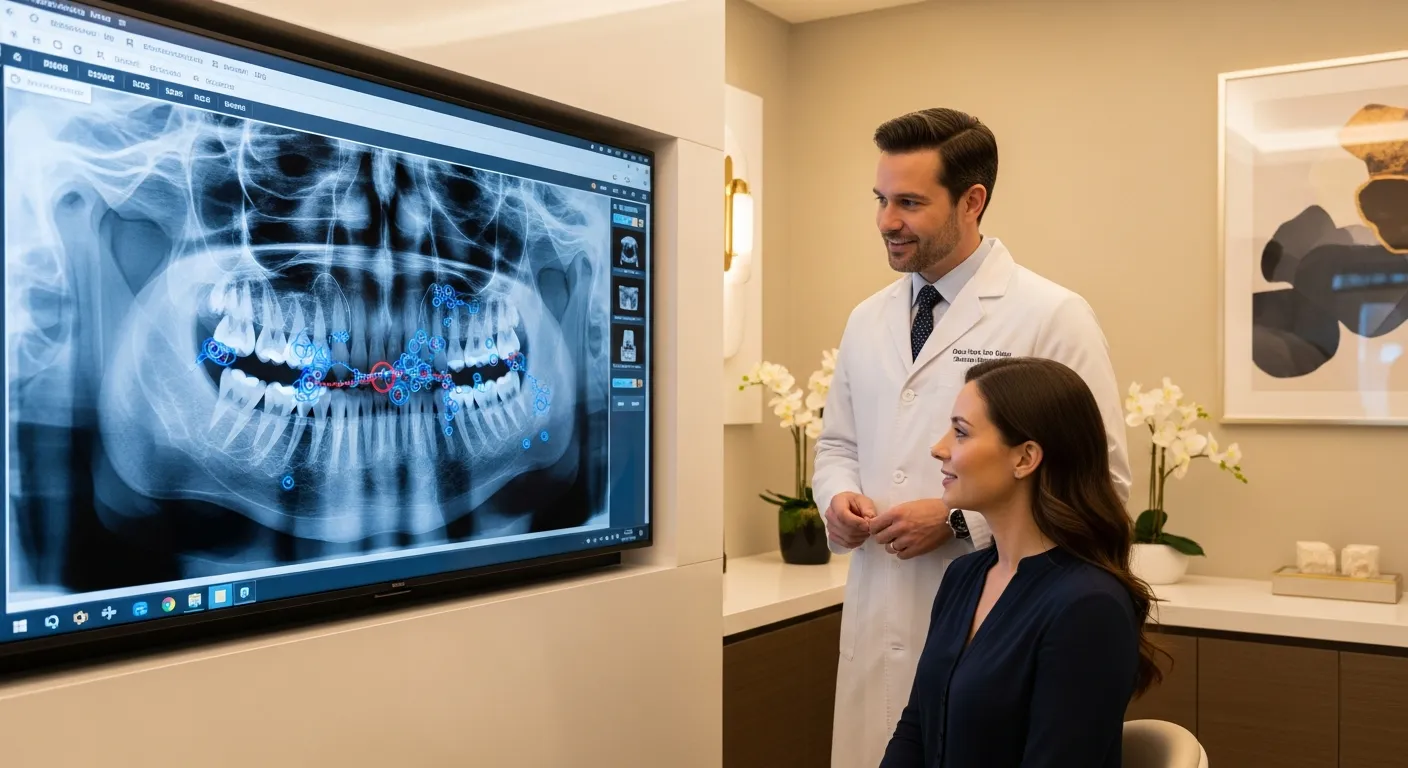
Your dentist just spotted something on your X-ray that you never would have seen. But it was not your dentist alone. An FDA-cleared artificial intelligence platform analyzed your radiograph in real time, highlighting areas of concern with color-coded overlays before your clinician even picked up the image.
This is not a glimpse of the future. This is how dental diagnostics work right now at practices that have embraced AI-powered technology.
Key Takeaways: AI in Dental Diagnostics
- AI dental diagnostic tools like Overjet have received FDA clearance for detecting decay, measuring bone levels, and identifying periodontal disease
- AI does not replace your dentist; it gives them a powerful second opinion that catches what the human eye might miss
- Practices using AI diagnostics report up to 27% higher case acceptance because patients can see exactly what the technology detects
- AI analysis happens in real time during your appointment, meaning faster and more accurate diagnoses
- When combined with 3D CBCT imaging and genetic testing, AI creates a complete picture of your oral and systemic health
What Is AI in Dental Diagnostics?
Artificial intelligence in dental diagnostics refers to software platforms that use machine learning algorithms to analyze dental images, radiographs, and clinical data. These systems are trained on millions of dental images, learning to recognize patterns that indicate decay, bone loss, periodontal disease, and other oral health conditions.
Think of it this way: your dentist has years of training and thousands of patient cases as their reference. An AI diagnostic platform has analyzed millions of images, building a knowledge base that no single clinician could match alone. When the two work together, the result is diagnostic accuracy that neither could achieve independently.
The technology works alongside your existing dental workflow. During a routine exam, your dental X-rays are analyzed by the AI in real time, producing annotated images that highlight areas of concern. Your dentist then reviews these findings, applies their clinical judgment, and discusses the results with you using visual evidence you can actually understand.
How Overjet Is Leading AI-Powered Dental Analysis
Not all AI platforms are created equal. Overjet stands out as the dental industry’s leading AI diagnostic solution, and for good reason: it is one of the few platforms with FDA clearance specifically for dental diagnostic applications.
What Overjet Detects
Overjet’s clinical intelligence platform performs several critical diagnostic functions:
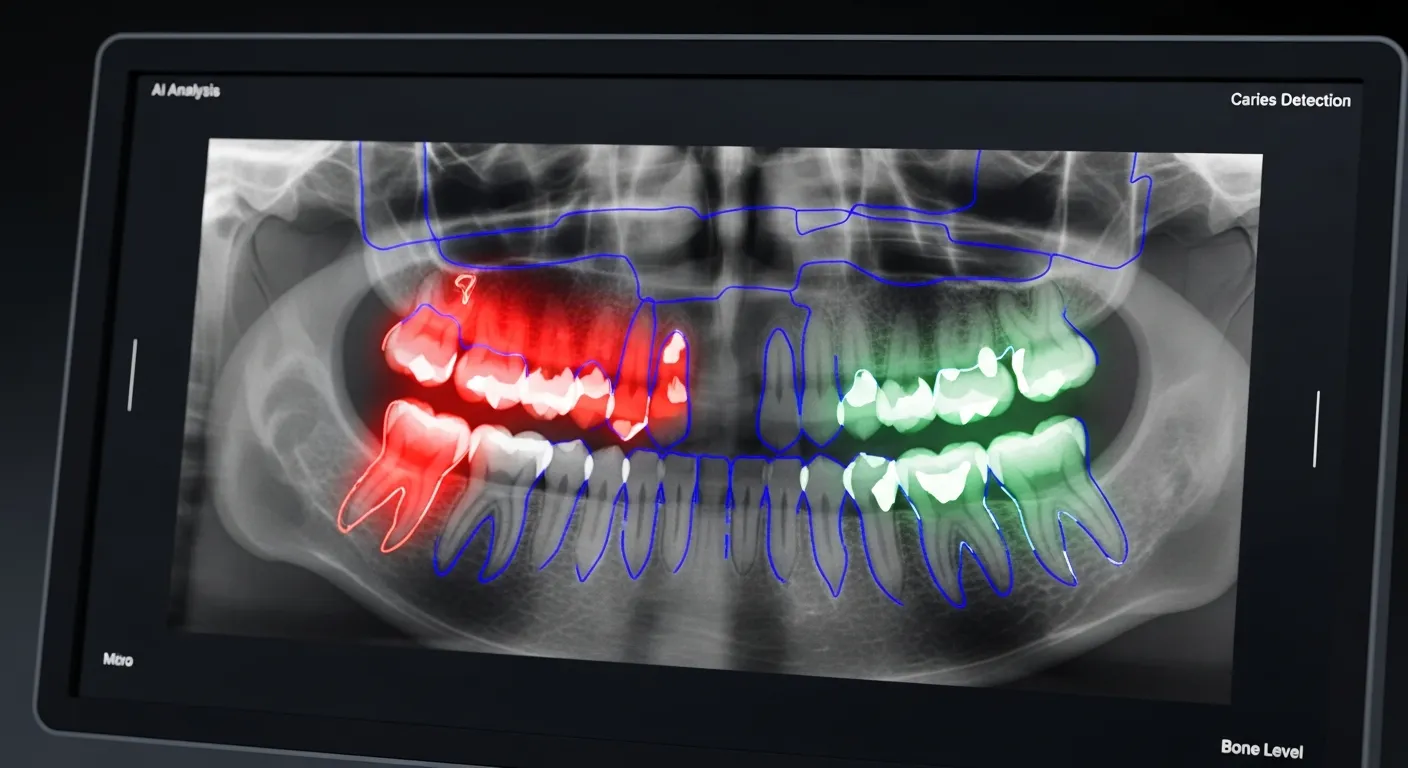
- Decay detection and outlining. The AI automatically identifies and outlines areas of tooth decay on radiographs with 93% accuracy, flagging cavities that might be in early stages and easy to miss visually.
- Bone level quantification. Rather than relying on subjective visual assessment, Overjet provides precise measurements of bone levels around each tooth, critical for periodontal disease management.
- Periodontal disease identification. The platform recognizes patterns consistent with gum disease, helping clinicians catch problems before they progress to tooth loss.
- Calculus detection. Tartar buildup that needs professional removal is automatically identified.
- Real-time analysis. Results appear immediately during your appointment, not days later.
Why FDA Clearance Matters
When an AI platform receives FDA clearance, it means the technology has undergone rigorous evaluation for safety and effectiveness. This is not a startup running unproven algorithms on your health data. FDA-cleared AI in dentistry has met the same standards of evidence required of medical devices, giving both patients and clinicians confidence in the results.
AI Plus Human Expertise: Why the Combination Matters
The most important thing to understand about AI in dental diagnostics is that it does not replace your dentist. It makes your dentist better.
Here is the reality: even the most experienced clinician can miss subtle findings on a radiograph. Fatigue, workload, image quality, and the inherent limitations of the human eye all play a role. AI does not get tired. It does not have a heavy patient load. It analyzes every pixel of every image with the same precision, every single time.
But AI also has limitations. It cannot feel the texture of a suspicious lesion, assess your pain levels, understand your medical history in context, or factor in your personal health goals. That is where clinical expertise becomes irreplaceable.
At Primary Integrative Dentistry, the approach is to combine AI-powered diagnostics with the clinical judgment of a prosthodontist specialist. Dr. Tzur Gabi, who has three additional years of specialty training beyond dental school, uses Overjet’s AI platform as an objective second opinion on every radiograph. The AI highlights areas of concern, and Dr. Gabi applies his expertise in reconstructive and restorative dentistry to determine the best course of action.
This combination produces measurable results:
- 43% reduction in diagnostic time, meaning less waiting and more efficient appointments
- 27% increase in case acceptance, because patients can see the evidence for themselves
- Improved consistency across visits, since the AI provides a standardized baseline for comparison
- Enhanced documentation that supports insurance claims with objective evidence
What AI Diagnostics Mean for Your Dental Visit
If you have never visited a practice that uses AI-powered diagnostics, here is what the experience looks like in practice.
During Your Exam
Your dental X-rays are captured using standard digital imaging equipment. The moment they are taken, Overjet’s AI platform begins analyzing them. By the time your clinician pulls up the images, they already have AI-generated annotations showing:
- Color-coded overlays highlighting areas of decay
- Precise bone level measurements around each tooth
- Markers indicating signs of periodontal disease
- Severity indicators that help prioritize treatment
Seeing Your Results
One of the most powerful aspects of AI-assisted diagnostics is patient communication. Instead of trying to decipher a grayscale X-ray while your dentist points to tiny shadows, you see clear visual overlays that show exactly what the AI detected and where. This transparency builds understanding and trust.
Better Treatment Planning
With more precise diagnostic data, your treatment plan becomes more targeted. AI helps identify problems at their earliest stage, when treatment is simpler, less invasive, and less expensive. For patients at Primary Integrative Dentistry, this aligns with the practice’s philosophy of proactive, preventive care rather than reactive treatment.
Beyond X-Rays: AI in the Context of Comprehensive Diagnostics
AI-powered radiograph analysis is a significant advancement on its own. But its real power emerges when combined with other advanced diagnostic technologies to create a complete picture of your health.
AI Plus 3D Imaging
3D CBCT (Cone Beam Computed Tomography) scanning captures a high-resolution, three-dimensional view of your teeth, jaw, sinuses, and airway. While traditional X-rays show a flat, two-dimensional image, CBCT reveals:
- Airway volume and restrictions related to sleep disorders
- Precise bone density measurements for implant planning
- TMJ joint structure and disc positioning
- Hidden root canal anatomy
- Early pathology that 2D imaging cannot detect
When AI analysis of standard radiographs is combined with 3D CBCT data, clinicians have an unprecedented level of diagnostic information available in a single appointment.
AI Plus Genetic Testing
DNA testing through the Caligenix partnership takes diagnostics even further by revealing your genetic predispositions. A simple cheek swab can identify your risk factors for periodontal disease, cavity susceptibility, inflammatory response patterns, and even how you metabolize anesthesia.
When you combine AI-detected current conditions with genetic risk profiling, your care team can build truly personalized prevention protocols. Instead of a one-size-fits-all approach, your treatment plan reflects both what is happening in your mouth right now and what your genetics suggest may happen in the future.
The Primary iD Health Scoring System
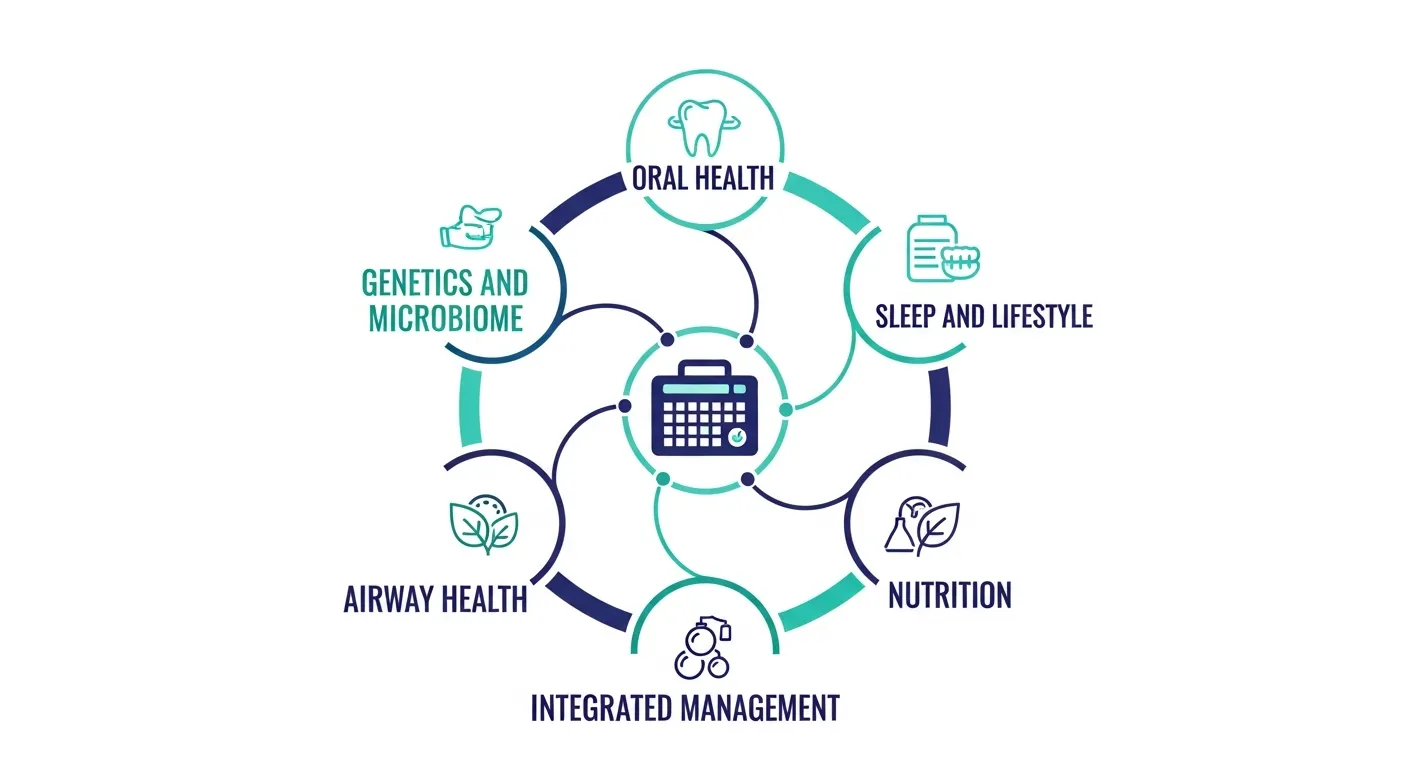
At Primary Integrative Dentistry, AI diagnostics feed into a broader health optimization framework called the Primary iD Health Scoring System. This proprietary system tracks your wellness across five dimensions:
- Oral Health – cavity risk, gum health, structural integrity
- Sleep and Lifestyle – quality metrics, energy levels, habits
- Nutrition – dietary analysis, supplementation needs
- Genetics and Microbiome – predispositions, bacterial balance
- Airway Health – breathing patterns, obstruction assessment
AI diagnostics provide the data foundation for the oral health dimension, while other advanced testing tools complete the picture. The result is a personalized health dashboard that connects your dental care to your total body wellness.
Detecting Systemic Health Risks Through Dental AI
One of the most exciting frontiers in AI dental diagnostics is the ability to identify signs of systemic health conditions through oral imaging. Research published in peer-reviewed journals like Frontiers in Dental Medicine and BMC Artificial Intelligence has demonstrated that AI models can detect patterns in dental radiographs that correlate with:
- Cardiovascular disease risk through inflammatory markers and bone loss patterns
- Diabetes indicators reflected in periodontal disease severity and healing patterns
- Osteoporosis through jawbone density analysis
- Sleep-disordered breathing through airway assessment combined with facial structure analysis
This is the foundation of integrative dentistry: your mouth is not separate from the rest of your body. The inflammation that shows up in your gums is the same inflammation affecting your heart, your gut, and your brain. AI helps quantify these connections with data, not guesswork.
At Primary Integrative Dentistry, this oral-systemic approach is central to every patient interaction. Dr. Gabi, known as “The Dental Architect,” has built his practice around the principle that the mouth is the gateway to total body wellness. AI diagnostics are one of many tools that make this philosophy actionable.
The Future of AI in Dentistry
The AI platforms currently used in dental diagnostics are just the beginning. Peer-reviewed research points to several developments on the horizon:
- Predictive analytics. AI models that can predict disease progression and recommend preventive interventions before problems develop
- Computer vision for oral cancer screening. Automated detection of suspicious lesions during routine exams
- Personalized treatment optimization. AI that learns from your individual health data over time, refining recommendations with each visit
- Integration with multi-omics data. Combining dental imaging with genetic, microbiome, and blood work data for truly comprehensive health assessment
Practices that adopt AI early, like Primary Integrative Dentistry, are positioning their patients to benefit from these advances as they become available. The digital infrastructure and clinical workflows are already in place.
How to Choose a Dentist Who Uses AI Technology
Not every dental practice has invested in AI-powered diagnostics. If this technology matters to you, here is what to look for:
- Ask about FDA-cleared AI platforms. Generic “AI features” in practice management software are not the same as FDA-cleared diagnostic AI like Overjet.
- Look for advanced imaging. Practices with 3D CBCT scanning and digital workflows are more likely to have integrated AI diagnostics.
- Check for specialist credentials. A prosthodontist or specialist with advanced training is better equipped to interpret and act on AI-generated diagnostic data.
- Evaluate the overall diagnostic approach. AI works best as part of a comprehensive diagnostic protocol, not as a standalone novelty.
Frequently Asked Questions About AI Dental Diagnostics
Is AI dental diagnostic technology safe?
Yes. FDA-cleared AI platforms like Overjet have undergone rigorous safety and efficacy testing. The AI analyzes your existing dental images; it does not require any additional procedures, radiation, or invasive testing. It is simply a more thorough way of reading the images your dentist already takes.
Will AI replace my dentist?
No. AI in dental diagnostics is a decision-support tool, not a replacement for clinical expertise. Think of it as giving your dentist a highly accurate second opinion on every radiograph. The final diagnosis and treatment decisions always come from your clinician.
Does AI dental analysis cost extra?
At practices that have invested in AI technology, the analysis is typically integrated into your standard exam and diagnostic imaging fees. It is part of the diagnostic workflow, not an add-on service.
How accurate is AI in detecting dental problems?
FDA-cleared platforms like Overjet achieve 93% accuracy in decay detection. Research published in peer-reviewed journals shows AI diagnostic accuracy ranging from 82% to 91% across various dental conditions, comparable to or exceeding the performance of experienced clinicians.
Can AI detect problems my dentist might miss?
Yes. Studies demonstrate that AI can identify early-stage decay, subtle bone loss patterns, and periodontal disease markers that may be difficult to detect through visual examination alone. This is particularly valuable for catching conditions in their earliest, most treatable stages.
What is the difference between AI diagnostics and regular dental X-rays?
The X-rays themselves are the same. The difference is in the analysis. With AI diagnostics, your images are analyzed by both your dentist and an AI platform simultaneously. The AI provides annotated overlays, precise measurements, and standardized assessments that enhance your clinician’s ability to detect and communicate findings.
